Quite possibly the most amateurish show ever to get nominated for a Best Musical Tony Award, Starmites was a musical that first appeared Off-Off-Broadway in 1980, played in several regional theaters then played Off-Broadway as part of the American Stage Festival and then arrived on the Great White Way at the tail end of what was probably the single worst season in Broadway’s history.
The story centered around a teenage girl (Liz Larson) who gets swept away to the world one of her favorite comic books, Starmites. There she meets the Starmites, “the punks of the future” (never mind that punk rock had pretty much run it’s course by then) who defend the galaxy against the evil Diva and fight to protect something called the All Spark. While Starmites aimed for a sort of Rocky Horror campiness we instead were treated to a dumb story, lousy score and high school level production values. Yet because it was one of three musicals still running by the Tony Award cut-off (Jerome Robbins Broadway and Black and Blue were the other two) the show managed to get six Tony noms. It failed to win any and closed shortly thereafter, accumulating just 60 performances. Currently there are three different versions available for license, including one for puppets.
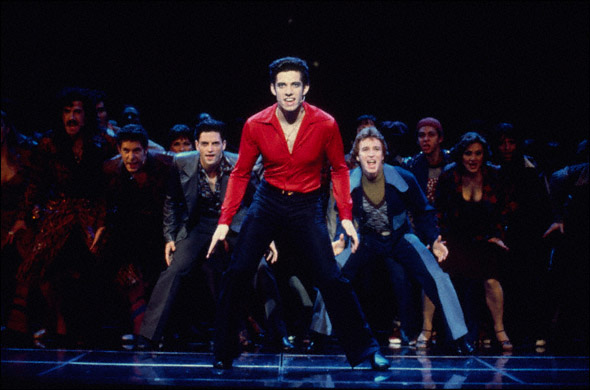
And speaking about disco and sucking…when a Broadway show’s poster actually advertises that it’s “Live on Stage” you know we’ve reached a new low. But that’s what the ads for this stage version of the classic John Travolta film read. Robert Stigwood, the once mighty record producer/movie and theater impresario who brought the original film to the screen produced the show, first in London where it played the London Paladium and ran just shy of two years. A Broadway production was rushed across the pond and opened with a $20 million advance sale. But as time has repeatedly shown an advance will guarantee that the show will run for a period of time, not that it will turn a profit.
Whereas the original Travolta film juxtaposed the gritty reality of Tony Manero’s working class existence with the phasmagoric world of the disco club, the stage musical was just a big gaudy production with the songs of the Bee Gees sung by a cast with none of the Gibb brothers harmonic gifts. There was some good choreography by Arlene Philips (who also directed) but in the end the whole show as a disco drag. It did eek out 501 performances but considering how hyped the show was this was one show that had trouble staying alive.
As you may remember, the late 1970’s were dominated by a little something called disco. This music genre/dance craze kicked off around the time Van McCoy recorded “The Hustle” and it reached it’s peak by decades end. Everyone and everything seemed to be putting on their boogie shoes and Broadway was no exception. Marvin Hamlisch went full disco for his musical They’re Playing Our Song and Ethel Merman recorded her infamous disco album. Stuck to the bottom of that dance floor was a little something called Got Tu Go Disco.
The book by John Zodrow (what, you never heard of him?) told of a young girl named Cassette, played by a post-Electric Company pre-Fame Irene Cara, who sells disco clothes at a boutique but hates the music, that is until her boyfriend takes her to a club and she becomes the belle of the ball. Mister Zodrow might have been the only librettist but upwards of ten different songwriters were responsible for the generic dance music. After many delays the show ran for nine previews and eight regular performances, not even long enough for it to face the wrath of the “Disco Sucks” movement.
In 1947 author Fred Saidy and lyricist E.Y. Harburg collaborated on the book of Finnian’s Rainbow. One of the most beloved musicals of the forties (though only occasionally revived today), Finnian’s Rainbow brilliantly mixed fantasy and whimsey with an anti-racism, socially conscious message.
Four years later, Harburg and Saidy again wrote another musical that blended fantasy with social commentary. Flahooley again had a libretto by the two men with Harburg providing the lyrics. Their Finnian’s collaborator Burton Lane was originally going to write the music. When he backed out Harburg approached his Wizard of Oz collogue Harold Arlen. When Arlen passed prolific songwriter Sammy Fain took up the mantel.
Produced by Cheryl Crawford and directed by Harburg and Saidy, Flahooley, like Finnian’s Rainbow, takes place in a fictional locale, in this case a city called Capsulanti. It is the headquarters of the largest toy company in the world, headed by the amoral B.G. Bigelow. A toy designer named Sylvester makes a new doll called a Flahooley which is meant to be the companies big Christmas product. Meanwhile a delegation from Arabia arrives with a magic lamp. Sylvester falls for the Arabian princess played on Broadway by Peruvian actress Yma Sumac (also making her Broadway debut was Barbara Cook). Sylvester summons the Genie of the lamp by rubbing it with the hand of one of his dolls. He wishes that every girl in the world could have a Flahooley. The Genie grants his wish but as a result the market is flooded with the dolls, leading to a hunt to track down and kill the Genie (don’t worry, it ends happily).
The storyline of Flahooley does echo that of Finnian’s Rainbow in a number of ways – the fictional U.S. location, a genie instead of a leprechaun. Yet that’s not the reason why the show failed. Flahooley was the victim of bad timing. It arrived at the height of Joseph McCarthy’s witch hunts, which Flahooley unabashely attacked. It also arrived just as the U.S. had entered the Korean War and many found the critical of capitalism story to be unpatriotic. Poor Flahooley only ran for 40 performances. This is too bad because aside from being both enchanting and daring the show featured a fine score and some wonderful puppets created by Bil and Cora Baird, the same people who would later create the marionettes for The Sound of Music.
A year later a revised version of Flahooley was produced for the Los Angeles and San Francisco Light Opera Company called Jollyanna. It received rave reviews and it was announced that it would open on Broadway, but as we’ll see time and time again, flop shows almost never get a second chance on the Great White Way. There have, however, been revivals presented both Off-Off-Broadway and at London’s Barbican Center as part of the “Lost Musicals” series.
Forty-four years before Spider-Man arrived on Broadway another costumed crime fighter attempted to take the Great White Way by storm. It’s a Bird, It’s a Plane, It’sSuperman had a lot going for it. A hilarious book by David Newman and Robert Benton (who would later write the screenplay to the Superman movie), a spunky score by Charles Strouse and Lee Adams, fine performances by Bob Holiday (Superman), Patricia Manan (Lois Lane) and an unknown Linda Lavin. All of which was orchestrated under the more then capable care of producer-director Harold Prince.
So what went wrong?
Well, casting Jack Cassidy in the rather minor role of evil restaurant critic Max Mencken didn’t help. It meant his role had to be beefed up to justify his star status. Having Superman fly around on a rope and harness looked pretty lame no matter how you cut it. But the biggest problem was that Superman opened just as the Batman TV series premièred. This bi-weekly program proved to be kryptonite to the man of steel and It’s a Bird, It’s a Plane, It’s Superman folded up his cape after just 129 performances. The show did have plenty of admirers and has had a good number of stock and amateur productions. The Dallas Theater Center produced a highly acclaimed production in 2010 with a new book by future Glee and Riverdale show-runner Roberto Aguirre-Sacasa, who was later summoned to New York to re-write the book to the ailing Spider-Man: Turn Off The Dark. More on that show later.
This Jules Styne-Betty Comden-Adolph Green musical wasn’t that bad a show or even that big a flop. Yet it lives on while many longer running shows have been forgotten. Why is that?
Well, for one thing the show featured Michael Bennett making his debut in the dancing chorus (he’s one of the Santa’s above). It’s also the show that won that Madwoman of Central Park West Phyllis Newman a Tony, beating out Barbra Streisand from I Can Get It For You Wholesale. But the big reason why this show looms large in the memory of so many theater buffs is that it was the recipient of what was perhaps the most outrageous publicity stunt ever concocted by that P.T. Barnum of Broadway, Mr. David Merrick.
When Subways opened to lackluster reviews, the maniacal producer found seven average Joes who happened to have the same names as New York’s seven leading drama critics. After taking them out to see the show and then taking them out to dinner he persuaded each of them to write a hyperbolic blurb praising the show. Merrick then printed up an ad boasting their “rave” reviews.
Only the New York Herald-Tribune carried the ad in their morning edition, but every paper reported on Merrick’s shenanigans, which did help jump-start the box office. It wasn’t enough for Subways to run more than 205 performances but for those of us who relish the art of the huckster, Subways is one for the ages.
Critics can say whatever they want to about him but Andrew Lloyd Webber has had one of the most remarkable careers in theater history. For over twenty years he enjoyed a streak of uninterrupted success with Jesus Christ Superstar, Joseph and the Amazing Technicolor Dreamcoat, Evita, Cats, Starlight Express, The Phantom of the Opera and Aspects of Love (though the latter was only a hit in London). His fortunes began to reverse with Sunset Boulivard, a pricey show that lost money despite long runs on both sides of the Atlantic. Then came Whistle Down the Wind, Lloyd Webbers first show since Jesus Christ Superstar to premier in the U.S.
The show was based on a 1961 English film of the same name, though Lloyd Webber, lyricist Jim Steinman (best known for writing songs for Meatloaf and Bonnie Tyler) and librettist Patricia Knop decided to set the musical in the Mississippi Delta country during the 1950’s. Lloyd Webber also reunited with his Evita and Phantom director Harold Prince.
Reports are mixed as to what exactly went wrong during the Washington tryout but this much is known. The show received poor reviews and Prince had trouble whipping the show into shape so Lloyd Webber decided to shutter the show in Washington. Prince has been reluctant to talk about WHISTLE DOWN THE WIND although he did say in an interview that “there WAS a play there”. Seeing as how the subsequent London mounting directed by Gale Edwards ran for three years, Prince was doubtlessly right.
Remember cranking up The Freewheelin’ Bob Dylan and dancing to “Blowing in the Wind”? Neither do I. The fact that Bob Dylan’s music is meant to be listened to, not danced to, was something that Twyla Tharp should have taken into consideration when she decided she wanted to follow-up her hit Billy Joel dance show Moving Out with another rock era songbook musical. And so she chose the songs of Bob Dylan, fashioning a loose story set in a traveling circus, The Times They Are a-Changin’ arrived after a tryout in San Diego. A hard rain did indeed fall when the critics reviewed the show and like a rolling stone it gathered no moss. Later Miss Tharp conceived Come Fly Away, a show in which swing dancers move to a live band and Frank Sinatra’s recorded vocals. It fared slightly better.
As we will discuss later on, the musical theater has tried over the years to follow the path of Hollywood and cash in on a shows success by mounting a sequel and time and time again they’ve failed. But before they decided to Bring Back Birdie, before Miss Hannigan tried to exact her revenge on little orphan Annie, before the Best Little Whorehouse went public and before the Phantom of the Opera taught us that Love Never Dies there was Let ‘Em Eat Cake, a sequel to George and Ira Gershwin’s 1931 musical Of Thee I Sing. A satire on Americas electoral system, Of Thee I Sing became the first musical ever to win the Pulitzer Prize for Drama and ran for a then very impressive 441 performances.
Two years later the Gershwin brothers reteamed with George S. Kauffman and Morrie Ryskind for a follow-up called Let ‘Em Eat Cake. William Gaxton was back as President J.P. Wintergreen, who this time around loses the presidency and instead leads a fascist coup to take over the government. The show ends with him narrowly escaping the guillotine.
Clearly, Let ‘Em Eat Cake was much darker than its predecessor. Having arrived in the very year that Hitler came to power in Germany, this cautionary tale was clearly a bit too much for depression weary audiences who wanted escapism. Let ‘Em Eat Cake only ran for 89 performances. It did produce one popular song, “Mine,” an instrumental version of which became the theme music for Everybody Loves Raymond.
Parenthetically, the original 1937 version of the British musical Me and My Girl had been a sequel to a show called Twenty to One, so there has been at least one successful attempt at writing a sequel for a main stem musical, albiet not on Broadway.
Richard Rodgers had not one but two of the most remarkable careers in the history of the American theater. On the one hand there was his collaboration with lyricist Lorenz Hart which produced such hit shows as The Garrick Gaieties, A Connecticut Yankee, Jumbo, On Your Toes, Babes in Arms, The Boys from Syracuse, Too Many Girls and Pal Joey. Then there was his more celebrated collaboration with Oscar Hammerstein II in which they revolutionized the musical with Oklahoma!, Carousel, South Pacific, The King and I, The Flower Drum Song and The Sound of Music.
After Hammerstein’s death in 1960 Rogers never again had a steady collaborator though he continued to work and produce some worthwhile musicals. He wrote his own lyrics for the hit No Strings, teamed up with Arthur Laurents and Stephen Sondheim for the commercially disappointing but melodious Do I Hear A Waltz and with Peter Stone and Martin Charnin wrote Two by Two, a musical about Noah and his ark which had a decent run thanks to Danny Kaye playing Noah. While these three shows at least all had decent runs his last two were clearly not up to his previous standards.
The first of these was Rex, a musical about Henry VIII. Sheldon Harnick wrote the lyrics and his The Rothchild’s collaborator Sherman Yellen wrote the book. The brilliant but temperamental British actor Nicol Williamson played the famed English monarch. Penny Fuller, who made a strong impression as Eve in Applause was cast as Princess Elizabeth and Glenn Close made her Broadway debut as Princess Mary (she’s the one on the left in the above photo). The show had a calamitous tryout and opened to terrible reviews. Needless to say, a show about one of the histories great misogynists didn’t fit in well during the women’s lib movement. Rex closed after a humiliating 49 performances. At the final curtain call someone in the cast said, “that’s a wrap.” Williamson misheard the remark as “that was crap” and he slapped the offending actor right in front of the whole cast and audience.
Rodgers wrote one more musical, another flop called I Remember Mama starring Norwegian film actress Liv Ullman. In 2010 a revised version of Rex was presented in Toronto with some success.




 THE 100 BIGGEST MUSICAL FLOPS IN BROADWAY HISTORY