With the colossal success of A Chorus Line choreographer-director Michael Bennett had the power to put on any show he wanted. The problem was that no matter what he did the critics were likely to compare his follow up to his monster hit. Bennett was well aware of this conundrum so for his next show he decided on a surprisingly traditional musical based on the TV movie The Last Dance at the Stardust Ballroom.
The simple story dealt with a lonely woman who frequents a ballroom in the Bronx where she falls in love with a married man. This was hardly heavy hitting material and as predicted the critics took Bennett to task. Three months later Ballroom danced its last dance.
Truth is, the show was much better than critics gave it credit for. Michael Bennett and co-choreographer Bob Avian provided some marvelous dances (and took home a Tony in the process), the physical production was beautiful and Dorothy Loudon gave the performance of her career as Bea Asher. Her eleven o’clock number “Fifty Percent” has gone on to become a cabaret standard.
Composer Henry Krieger hit the bulls eye his first time on Broadway with Dreamgirls. He then enjoyed a modest success with The Tap Dance Kid in 1984. It was thirteen years before Broadway heard another Henry Krieger score.
Side Show was a musical with book and lyrics by Bill Russell that told the real-life story of conjoined twins Daisy and Violet Hilton (Emily Skinner and Alice Ripley) who rose from a circus midway to vaudeville stardom.
Side Show was one of many potentially great shows that were the victim of dire Broadway economics. The show made the mistake of opening “cold” on Broadway rather than receiving an out-of-town tryout or a regional theater production, thus arriving on Broadway in a very rough form. The show received good reviews, particularly for their joined-at-the-hip leading ladies. Side Show attracted a furious cult following, but not enough to fill the Richard Rodgers Theater. Unable to keep the show open at a loss the show ran for only 91 performances. Fans of the show were so incensed that they picketed the shows closing.
Soon after the shows closing there were rumors that it would re-open. This proved to be wishful thinking. But within a year, other productions were being mounted, including an acclaimed production in Denver starring a cast of physically challenged actors. Side Show has since received numerous productions. In 2014 a much-revised version of Side Show directed by Bill Condon came to Broadway after playing the La Jolla Playhouse and the Kennedy Center. Though well reviewed the new production only lasted seven weeks on the Great White Way.
Actors (L-R) Patti Lupone & Topol in a scene fr. the Broadway musical “The Baker’s Wife.”
Composer-lyricist Stephen Schwartz was living a charmed life in the early seventies. His first Broadway credit was writing the title song to Leonard Gershe’s play Butterflies are Free. His song was heard on Broadway 1,128 times. Schwartz next wrote the score to Godspell, which ran five years Off- Broadway, a year and a half on, and has had thousands of productions all over the globe. This was followed by the Broadway hits Pippin and The Magic Show, each of which ran for over 1,900 performances.
Schwartz paid his dues, however, with his fourth musical, The Baker’s Wife. The irony is that not only did he provide the show with his best score to date, but he also provided the show with one of the most ravishing scores ever written for any show, ever!
The Baker’s Wife was based on a famous French film by Marcel Pangol. David Merrick, who’s first hit Fanny had been based on a trilogy of Pangol films, had acquired the rights to the film and hired Joseph Stein (Fiddler on the Roof) and Schwartz to write the book and score respectively.
Unfortunately the show was produced during Merrick’s coked out sojourn in Hollywood. The show opened at The Dorothy Chandler Pavilion, home of the Academy Awards, much bigger than any Broadway house and way too big for an intimate musical about a baker and his wife. During the tryout actor Topol was replaced by Paul Sorvino while Carole Demas was replaced by a young dynamo named Patti Lupone. But by the time the show ended its second engagement at the Kennedy Center the show was beyond repair and Stein and Schwartz petitioned the dramatist guild to have the show close on the road.
After the shows closing the two creators pooled their money together and produced a cast album that quickly attained a furious cult following. The aria “Meadowlark” became a favorite audition song. It caught the attention of Cats and Les Miserables director Trevor Nunn, who mounted a West End production that unfortunately padded the material with additional characters and extra songs. It didn’t last very long.
While The Baker’s Wife may be too delicate to ever fully work as a musical, it has received a number of revivals in the years since and its gorgeous score will continue to attract fans.
Schwartz would go on to make the greatest of Broadway comebacks with Wicked in 2003. Still, an interesting thing about Mr. Schwartz is that while he’s had several huge hits his flops like The Bakers Wife, Working, Rags and Children of Eden have all proven to have legs, receiving numerous productions after their ill-concieved originals had folded.
Sequels are de rigueur in Hollywood, but somehow that’s a nut that the musical theater has yet to crack as shows like Annie 2: Miss Hannigan’s Revenge, The Best Little Whorehouse Goes Public and Love Never Dies have shown us. But before any of these sequels proved to be unequals there was Bring Back Birdie.
This sequel to Bye Bye Birdie brought back original creators Michael Stewart (book), Charles Strouse (music) and Lee Adams (lyrics). Leading lady Chita Rivera also signed on. One person who didn’t reprise his services was original star Dick Van Dyke, so Donald O’Connor opted to play record producer Albert Peterson.
Set twenty years after Bye Bye Birdie, Albert and Rose (Rivera) must track down an aging Conrad Birdie so that he can appear on a television special. Nothing about this mess worked and Bring Back Birdie said bye bye after four performances. During one of the final performances Donald O’Connor forgot the lyrics to one of the songs. He told the conductor “you sing it, I hate this song” and walked off.
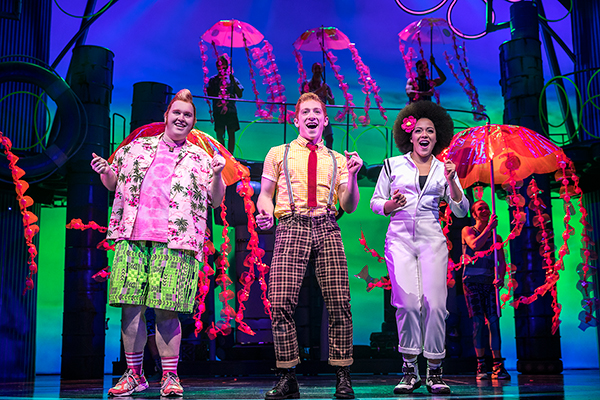
Since 1999 the Nickelodeon cable network has made a killing off of the eternally optimistic sea sponge and eponymous star of the animated series SpongeBob SquarePants. Reportedly the show and its merchandising tie-ins have grossed some $13 billion since the shows premiere. Even Mr. Krabs couldn’t dream that big! And while animated films such as Beauty and the Beast, The Lion King and Anastasia have successfully translated to the stage, SpongeBob SquarePants: The Broadway Musical was the first attempt at turning an episodic cartoon series into a big, splashy Broadway musical.
The musical was adapted for the stage by Kyle Jarrow and directed by Tina Landau best known for directing plays for the Steppenwolf Theater Company and co-writing and directing the acclaimed Off-Broadway musical Floyd Collins. To write the score a whole host of well-known pop-singers including Sara Bareilles, Steven Tyler and Joe Perry, John Legend, The Flaming Lips and They Might Be Giants all contributed songs.
The show premiered in Chicago where it received largely excellent reviews, with high praise for the production design, giddy atmosphere and imaginative way of realizing the familiar cartoon characters on stage. The show went to the Palace Theater on Broadway where it was again well received but despite a run of 327 performances, the show closed without recouping it’s $18 million budget.
So, what went wrong? The producers blamed a renovation on the Palace Theater for its closing, but this was almost certainly a face-saving measure. The truth is that the show was treading water and unable to meet its weekly expenses. Though orchestrator Tom Kitt was praised for giving the score written by a disparate team of writers a sense of continuity, the producers should have known better. Shows written by committee rarely work and it’s a neccessity to have the songwriter(s) present during the entire creative process, rather than a pop star who just submits material. But perhaps the biggest reason for the show’s failure might well be the main reason it was produced in the first place. Because SpongeBob had been a hugely successful media franchise for eighteen years, people were reluctant to spend a hundred bucks a ticket to take their kids to see something that airs multiple times every day on cable.
Hopefully, SpongeBob will have an afterlife. A national tour is scheduled to open in September and the show seems like a shoo-in for school and armature theater groups.
Though Bob Fosse had been dismissed from the 1960 flop The Conquering Hero (which opened with no director or choreographer credited) and though his production of Frank Loesser’s swan song Pleasures and Palaces closed on the road, choreographer-director extraordinaire Bob Fosse’s name never graced a Broadway flop until his twelfth and final new musical.
Like Sweet Charity, Big Deal was based on a well-known Italian film (“Big Deal on Madonna Street”). Like Chicago, Big Deal was set in the windy city of Fosse’s youth. And like Dancin’, Fosse chose not to hire a songwriter, opting instead to cull such standards as “I’m Just Wild About Harry” and “Me and My Shadow” to make up the score. The obvious problem was that none of these songs helped advance the weak libretto that Fosse himself had written.
Of course, a Bob Fosse musical was bound to have some great dancing, and the great man would end up winning a Tony Award for his choreography. But the show wasn’t a hit, closing after just sixty-nine performances.
Right after Big Deal opened, Fosse directed a revival of Sweet Charity starring Debbie Allen that was warmly received. While supervising that shows national tour in Washington, D.C. Fosse collapsed on the street and died of a fatal heart attack. Thanks to the ultra-long running revival of Chicago (currently Broadways second longest running show), the dance retrospective Fosse and the acclaimed mini-series Fosse/Verdon, the great song and dance man’s legend continues to loom large as ever.
When a show flops it’s usually pretty apparent as to why it failed. A lousy book, incompetent producers, ugly sets, miscast leads, a score that sounds like fingernails on a chalkboard. But sometimes a show flops despite a cornucopia of virtues and no one can quite agree on what went wrong.
A perfect example of this phenomenon is Mack and Mabel, a show that dealt with the often-stormy relationship between silent film director Mack Sennett (Robert Preston) and actress Mabel Normand (Bernadette Peters). The show reunited the principal creative team behind the monster hit Hello Dolly- Book writer Michael Stewart, composer-lyricist Jerry Herman, producer David Merrick and choreographer-director Gower Champion. The show got off to a promising start when it premièred in California but somehow as it made its way towards New York the changes made proved to be detrimental. The creators didn’t throw the baby out with the bath water but Mack and Mabel opened to mixed reviews and only ran for eight weeks.
So what exactly went wrong? Some blame the shows downbeat ending. Perhaps, but by 1974 audiences had long embraced tragi-musicals like Man of La Mancha and Cabaret and the ending of Mack and Mabel, in which Mack admits that he always loved Mabel Normand, was positively moving. Jerry Herman blames Gower Champions decision to set the show on a Hollywood sound stage. Gower Champion claimed that the main problem was that he couldn’t figure out how to re-create the kinetic energy of a Keystone Cops chase. What certainly wasn’t to blame, even though it received the brunt of the critics’ ire, was Jerry Herman’s wonderfully melodious score, one of the best he ever wrote.
Like many shows on this list, Mack and Mabel was kept alive thanks to a stellar cast album. The show found favor in Great Britain and a 1995 West End production won the Laurence Olivier Award for Best Musical. The show has also received a number of productions in its homeland, including a revised (and some say watered down) revival at the Papermill Playhouse. “I Promised You A Happy Ending,” sang Mack Sennett at the end of the show, and that’s just what Mack and Mabel received.
With the success of Brigadoon, My Fair Ladyand Camelot, some on Broadway thought that Alan Jay Lerner and Fredrick Lowe were poised to succeed Rodgers and Hammerstein as Broadways foremost songwriting team. But after an unpleasant experience bringing Camelot to New York, Fredrick Lowe decided to retire. Alan Jay Lerner, however, remained quite busy tackling a bunch of ambitious musicals while going through more wives then Solomon. Though Lerner sought out some of the best composers in the business, including Burton Lane (On a Clear Day You Can See Forever, Carmelina), Andre Previn (Coco) and Leonard Bernstein (1600 Pennsylvania Avenue), he never managed to regain his mojo.
Lerner’s last Broadway musical was Dance a Little Closer, which he co-wrote and directed while Charles Strouse provided the music. The show was based on Robert Sherwood’s play Idiots Delight and centered on a group of rich and beautiful people facing the threat of nuclear warfare while vacationing in the Austrian Alps. While the shows heart was in the right place, this Alpine Grand Hotel didn’t click. Even in those pre-twitter days Broadway haters knew how to poison the well and they soon dubbed the show “Close A Little Sooner”. That’s precisely what it did, opening and closing on the same night.
Though Dance a Little Closer was his last musical, Lerner never actually retired. Before he died he was in talks with Andrew Lloyd Webber about a musical version of The Phantom of the Opera. Who knows?
Dancers perform the musical, Jerome Robbins’ Broadway.
The 1988-1989 Broadway season is generally considered to be the worst in Broadway history. Not a single play or musical that opened that season saw a return on its investment. It was such a dismal season that when Peter Filichia wrote his book Broadway Musicals: The Biggest Hit & the Biggest Flop of the Season – 1959 – 2009 he simply left the first half of the 1988-1989 season blank.
On the surface, Jerome Robbins Broadway would probably count as the biggest hit (although the French import Black and Blue had a longer run). It won most of the seasons Tony Awards (mostly by default) and was certainly the most anticipated show of the season. But in the minds of most theatergoers it was a big letdown.
The great Jerome Robbins had neither choreographed nor directed a new musical since Fiddler on the Roof back in 1964. He always said that if the right show came his way he would return to Broadway. By 1988 that show hadn’t crossed his desk. Still, after staging a retrospective of his Broadway dances for the New York City Ballet the all mighty Shubert Organization gave Robbins a blank check and all the rehearsal time he wanted to turn that retrospective into a Broadway revue.
When Jerome Robbins Broadway opened, critics gushed. This was the real Broadway, they decreed. Songs and dances, not crashing chandeliers or students holding a barricade! But audiences weren’t fooled. They knew a recycling job when they saw it. Jerome Robbins Broadway ended up only recouping half of its $8 million budget and the road company fell apart.
Side note: Appearing as both the Emcee and in other roles was Jason Alexander who not only won a Tony but within a year, would take up residence in a certain TV show about nothing.
With a run of 685 performances one can certainly argue that The Little Mermaid does not belong in the flop category. They have a point. But remember, a big part of this lists criteria is whether or not the show in question fell below expectations. And in the case ofThe Little Mermaid those expectations fell well below sea level.
On the surface, it must have seemed like a no brainer. The Little Mermaid was a Disney classic filled with wonderful tunes by Alan Menken and the late Howard Ashman and is generally credited with jump-starting the Disney renaissance of the late 80’s/early 90’s. It certainly seemed like a better recipe for success then The Lion King or a stage version of a flop movie like Newsies.
But as producers have learned time and time again, there’s no such thing as a sure thing on Broadway and usually the sure things turn into a sure flop.
In a clear attempt at repeating the kind of alchemy that made The Lion King into such a sensation, Disney theatrical president Thomas Schumacher hired acclaimed opera director Francesca Zambello to re-conceive this animated film into a unique stage experience. What they ended up with is a bunch of mermaids skating across the stage in heelies, a set that looked like a Palm Beach restaurant and a climax that many found confusing. Not enough Disney freaks took the bait and Mr. Schumacher wisely ended the Broadway engagement to put the show on the road.
On the plus side the show marked the Broadway debut of Sierra Boggess as the title character. She has since appeared in Love Never Dies, The Phantom of the Opera, an acclaimed revival of Master Class and School of Rock. Her career seems to be going swimmingly.




 THE 100 BIGGEST MUSICAL FLOPS IN BROADWAY HISTORY