92. VERY WARM FOR MAY (1939)

It’s hard to believe today but there was a time when the music industry was so dependent on Broadway for its songs that even a number from a flop could be a hit tune.  This was true of “All Things You Are” from the 1939 Jerome Kern-Oscar Hammerstein flop Very Warm For May.

Twelve years prior, Kern and Hammerstein made history with their trailblazing masterpiece Show Boat.  They followed up with the hits Sweet Adeline and Music in the Air.  After a prolific sojourn in Hollywood, Kern returned to Broadway to collaborate with Hammerstein on Very Warm For May.  Vincent Minelli directed the production which during its out-of-town tryout centered on a society matron (Eve Arden) who, in order to escape the wrath of some gangsters, joins an avant-garde theater group in Connecticut to hide out.  Co-starring June Allyson and Vera-Ellen, the show actually received rave reviews on the road but when producer Max Gordon caught up with the show, he decided he didn’t like the gangster subplot and ordered it to be removed, proving the old adage that if it ain’t broke, don’t fix it. Brooks Atkinson in the Times wrote that “Very Warm For May is not so hot for November” and the show was crushed from competing production such as Du Barry Was A Lady and Too Many Girls!.  Very Warm for May closed after just two months.

Kern and Hammerstein never worked together again, and Hammerstein had to wait until he teamed up with Richard Rodgers to write Oklahoma! before he got his mojo back.  “All Things You Are,” meanwhile, became a standard, recorded by the likes of Ella Fitzgerald, Frank Sinatra and even Michael Jackson.

93. PLATINUM (1978)

A once great movie star is attempting a comeback.  Along the way she becomes obsessively in love with a much younger man.  Does this sound familiar?  Fifteen years before Andrew Lloyd Webber musicalized Billy Wilder’s film Sunset Boulevard another, somewhat indirect attempt was made.  The show was designed as a starring vehicle for Alexis Smith in her first major role since her Tony Award winning triumph in Follies.  In the show she played Lilla Halliday, a Doris Day type movie-musical star attempting to make a comeback as a rock/disco singer.  Originally titled Sunset, it was first seen at the Studio Arena Theater in Buffalo and was directed by Tommy Tune.  The music and lyrics were by Gary William Friedman and Will Holt, who had achieved success Off Broadway with their critically acclaimed show The Me Nobody Knows.  For Broadway, Will Holt re-wrote the book along with future Hollywood Squares panelist Bruce Vilanch.  Joe Layton directed and choreographed.

Platinum was panned by Walter Kerr in the Times but was praised by Douglas Watt in the Daily News and Martin Gottfried in The New York Post.  In the end audiences weren’t interested and the show closed after just 33 performances.  Setting the show primarily in a recording studio was probably not such a hot idea.  As Disney would learn with their unsuccessful road show On the Record, a recording studio can be very confining.

Platinum has gone on to enjoy something of a cult following. A recording of the original version titled Sunset was released and in 2010 the show was presented at the FringeNYC festival.  In his book The Complete Book of 1970’s Broadway Musicals Dan Dietz wrote that the score to Platinumwas “one of the most underrated of the era.”

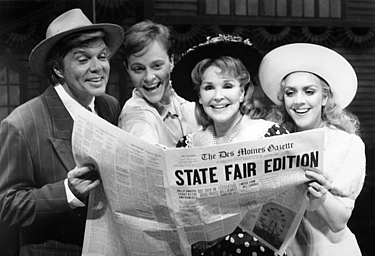
94. STATE FAIR (1996)

State Fair

When the Abominable Showman David Merrick was trying to produce Fanny, his first musical, he tried to get none other than Rodgers and Hammerstein to write the book and score.  They were interested in writing it, but not in partnering with Merrick.  Instead of letting Dick and Oscar buy him out, Merrick and the shows director Joshua Logan produced it themselves.  Fanny ran for 888 performances and established Merrick as a Broadway impresario to be reckoned with.  

Flash forward forty-two years.  A stage version of Rogers and Hammerstein’s only movie-musical State Fair was produced back in 1992 and toured the country.  The creators very much wanted to bring it to Broadway, but the money was not forthcoming.  Enter an enfeebled, eighty-five-year-old David Merrick who was willing to put up the money for a Broadway production provided that his name be the only one above the title. Merrick got his wish and State Fair opened on March 27, 1996 in a production co-directed by Randy Skinner and James Hammerstein (son of Oscar).  

Alas, the critics weren’t too kind to this kettle of Iowa corn and any hope it had of having a decent run was dashed when State Fair was denied a Tony nomination for Best Musical.  The show was nominated for Best Score, but only for four songs that did not appear in the State Fair film or it’s 1962 remake.  This led to one of Merrick’s notorious law suites, the last of his many grand publicity stunts.  Alas, the suite was thrown out and State Fair packed up after just 110 performances.  Merrick never produced another show and he passed away four years later, a largely forgotten man.  Still, he could at least boast to have produced one Rogers and Hammerstein show in his illustrious career.

95. CRY-BABY: THE MUSICAL (2008)

Call it Deja-Broadway. A hit show comes along and the people in charge try to make lightning strike twice, and it almost never does. David Merrick had a hit turning Billy Wilder’s film The Apartment into Promises, Promises so he tried another Wilder classic, in this case Some Like It Hot, which became Sugar. Not as good and nowhere near as big a hit.  Mel Brooks scored a hit with The Producers only to stumble with Young Frankenstein.  Heck, even Baby It’s You!, a jukebox musical about the Shirelles might as well have been called Jersey Girls.  And after John Waters 1988 film Hairspray was turned into a Broadway smash, a second Waters-film-to-stage adaptation was all but inevitable.

The question was, what film from this Baltimorean’s cannon was right for the stage?  His seventies underground films like Pink Flamingo’s, Female Trouble and Desperate Living were all a bit too much for Broadway, and his films Serial Mom, Pecker and Cecil B. Demented didn’t create that much of a splash.  So, Waters 1990 film Cry-Baby was chosen.  A spoof on teenage rebellion films of the fifties, Cry-Baby the movie is most noteworthy for giving Johnny Depp his first starring role.  The musical reunited Hairspray’s book writers Mark O’Donnell and Thomas Meehan to the fray while Adam Schlesinger wrote the music and David Javerbaum the lyrics.  After a tryout in San Diego Cry-Baby arrived at the flop prone Marquis Theater.    Ticket buyers who probably expected another light-hearted romp like Hairspray were instead treated to a show with songs like “The Anti-Polio Picnic,” “Watch Your Ass” and “I’m Infected.”  Ben Brantley in the Times said that Cry Baby “has all the saliva-stirring properties of week-old pre-chewed gum.”  The show did manage to get four Tony nominations and Rob Ashford won a Drama Desk Award for his choreography.  In the end though, Cry Baby only lasted for sixty-eight performances.  Maybe the producers should have gone with Pink Flamingos.  Or maybe they should have realized that Hairspray was a once-in-a-lifetime hit and found another, more original property 

96. SMILE (1986)

ffa3dc729ce1cb1bceac3ac50c2e7991--broadway-posters-window-cards.jpg

Easily one of the most undeserving flops on this list, Smile paired A Chorus Line’s Marvin Hamlisch with Howard Ashman, the librettist-lyricist-director of the Off-Broadway smash Little Shop of Horrors.  Ashman wore the same three hats on Smile and just as he had with Little Shop, he took a hardly great source material – in this case a rather mean spirited 1975 film – and infused it with heart and depth.  The show centers around a teenage beauty pageant and the unlikely friendship that forms between two contestants.  Smile easily had Hamlisch’s best post-Chorus Line score and Ashman’s direction was fluid and lively.  The second act closer “Until Tomorrow Night” was a tour du force.  Smile also received a rare bit of publicity when 60 Minutes began to cover its out-of-town tryout.  Alas, the critics didn’t give the show a chance and Smile turned in its tiara after 48 performances.

If the failure of Smile weren’t bad enough, it might be one of the best shows in history not to have a cast recording made, though a demo tape has been circulated.  Some of the songs made their way into Fynsworth Alley’s Unsung Musicals CD collection, including the title song, the beautiful “In Our Hands” and, prophetically, a song called “Disneyland” sung on stage by Jodi Benson.  Mr. Ashman later went to work at Disney writing the lyrics for The Little Mermaid and sure enough it was Miss Benson who provided the voice of Ariel.

97. CANTURBURY TALES (1969)

Image result for Canterbury Tales Broadway

Anyone who lived through the so-called “British Invasion” of the 1980’s and early 1990’s when shows like Cats, Me and My Girl, Les Misérables, The Phantom of the Opera and Miss Saigon ruled the Great White Way might be surprised to know that there was a time when British musicals were treated as an occasional curiosity.  Sure, a few shows like The Boy Friend, Oliver! and Stop the World-I Want to Get Off succeeded on Broadway but on the whole the relatively few musicals born in Britain rarely went to Broadway and when they did, they rarely repeated their success in New York.

One such show was Canterbury Tales, a bawdy, lyric version of Chaucer’s famous stories such as “The Miller’s Tale,” “The Steward’s Tale” and “The Wife of Bath’s Tale.”  A giant hit in London, the show ran for 2,080 performances on the West End.

It was Frank Loesser of Guys and Dolls and How to Succeed in Business Without Really Trying fame who decided to bring the show to Broadway.  Unfortunately, the show couldn’t compete with musicals like Hair and 1776 and closed after just 121 performances.  There was, however, a very successful post-Broadway tour directed by James Hammerstein (Oscars son) that was so successful that there was talk of bringing the production to Broadway.  Alas, as is so often the case when such rumors circulate, it turned out to be nothing more than wishful thinking.

So why did the show triumph on it’s native soil but not in the Big Apple? Was it too English? Was the timing wrong? Questions like these will be asked many times as we take our journey through Broadway flopdom.

98. BLOODY BLOODY ANDREW JACKSON (2010)

Rock and Roll has always been about adolescent angst.  So why not write a rock musical about our country during its adolescence?  

Bloody Bloody Andrew Jackson was a unique, anachronistic rock musical about the seventh President of the United State, presented as an angry young rock singer.  The show took a darkly comic look at the age of Jackson while not shying away from his genocidal tendencies.  The show opened to great success first at the Kirk Douglas Theater in Culver City and then at the Joseph Papp Public Theater.  The show then transfered to Broadway where it looked like a shoo-in but despite excellent reviews the show just didn’t attract an audience and closed after just 120 performances.

Like many musicals on this list, it’s hard to pinpoint exactly why Andrew Jackson failed on Broadway.  Perhaps it was the violent subject matter or perhaps it just worked better Off-Broadway.  Alas, the cost of producing Off-Broadway has gotten so hazardous and the potential profits so meager that many a show’s producers would rather risk a on Broadway run rather than an open ended one off.

In the long run, Bloody Bloody Andrew Jackson has found an afterlife in regional theaters and in colleges.  It’s also found some unwanted controversy as Native American groups have protested the show.

It’s worth mentioning that despite the commercial failure of Bloody Bloody Andrew Jackson it didn’t prevent the Public’s artistic director Oskar Eustis from producing a hip-hop musical about one of our founding fathers. Why Hamilton became a sensation and not Bloody Bloody Andrew Jackson is certainly open for discussion.

99. THE ROCKY HORROR SHOW. (1975)

Today it’s the mother of all cult musicals thanks to The Rocky Horror Picture Show, the film version of this campy dragfest which has been encouraging fans to do the Time Warp again (and again and again and again….) every weekend for well over forty years.  But while the stage show that it was based on had a long run in London (nearly 3,000 performances) and also triumphed in L.A. at the Roxy Theater, it landed like a thud on Broadway.

Why did it do so badly? After all the show had a killer rock score and a first-rate cast that included Tim Curry, Meatloaf and the show’s creator, Richard O’Brien (billed as Ritz O’Brien on stage).  Maybe it was all a little too much for the New York theater critics.  The show also had the grave misfortune of opening after Broadway had been assaulted with a slew of dreadful post-Hair rock musicals like Soon, Dude, Via Galactaca and others.

Ironically, the film version was shot right before Rocky Horror came to Broadway.  After the show’s forty-five performance Broadway run  20thCentury Fox, the film’s distributor, had no faith in the movie and basically dumped it in theaters where it came and went before you could say “Sweet Transvestite.”  But on April 1, 1976 the Waverly Theater in Greenwich Village screened the first ever midnight showing of The Rocky Horror Picture Show. Soon fans began coming to see the show in costumes, shouting back at the screen and acting the film out while it’s being projected.  All of this helped the stage show, which went on to be a cult hit in the States and has had many touring and amateur productions since then.  In 2000 a revival opened at the Circle-in-the-Square Theater where it ran for 437 performances, a helluva lot longer than the original.  And unlike the movie, the cast could shout back at the audience.  Maybe the interaction was the missing ingredient to the show when it first opened?

100. BUSKER ALLEY (1995)

One could make the argument that this 1995 musical doesn’t deserve to fall into the flop category because it was an unforeseeable accident that caused the show to close before its planned Broadway opening…Namely it’s leading man Tommy Tune breaking a leg during the tryout (we’ve got to come up with a different term for “good luck”).  It’s a fair point to make but since Busker Alley had to shut down prior to its Broadway debut it is therefore eligible for this list.

Based on the movie St. Martin’s Lane, the musical was the brainchild of A.J. Crothers, a screenwriter at the Walt Disney Company and Disney’s resident songwriting team, Richard and Robert Sherman, who wrote the songs to Mary Poppins and The Jungle Book among others.  Originally the show was called Piccadilly and was completed in 1969.  A whole quarter of a century would pass before the musical made it to the stage.

Busker Alley became a reality when Tommy Tune agreed to star in this musical about street performers, or “Buskers”, in 1930’s London. The show began a sixteen-city tour in Louisville, Kentucky and went on to enjoy considerable success and was to open at the St. James Theater but six weeks prior to the shows Broadway bow Tommy Tune broke his foot (okay, not his leg) and the production was cancelled.

Tune never got to star in the show on the New York stage but Busker Alley did get a hearing in 2006 when the York Theater company presented a one-night only concert which reunited both Jim Dale and Glenn Close from Barnum.  There was talk of a Broadway production in 2008 but it never materialized.  A cast album was released and if the book is as good as the songs then Busker Alley is totally worth restaging.

THE 100 BIGGEST MUSICAL FLOPS OF ALL TIME

Ah Broadway, you’re an unpredictable place.  Somehow, you’ve taken the most unlikely ideas – a lyric re-working of Pygmalion, a show about dancing cats, a hip-hop musical about Alexander Hamilton – and turned them into hits while many “better” ideas fall by the wayside.  

Truth is, you are a harsh mistress, seeing as how nine out of every ten shows that open on your Great White Way close in the red.  Indeed, the old adage is true, that you can’t make a living in the theater, but you can make a killing!

Every season a number of shows open.  One or two might become smash hits and run for years and years.  Two or three others might run for a year or two and might recoup most or all of their investment, maybe even see a profit.  But then there will be the many more that will run for only a few months, weeks or days.  Some open and close on the same night.  Some close on the road, some during their New York previews.

This list is meant to give an overview of musicals that were not just unsuccessful, but that left their mark none-the-less.  Some were major disappointments that fell well below industry expectations.  Some were potentially great but needed more work. Some were great and just needed, or in some cases received, another showing. And some were so awful that you have to wonder why anyone would put up the money to produce such a show (though someone obviously did).

So here I give you The 100 Biggest Musical Flops in Broadway History.  To meet these criteria the show in question had to either open on Broadway or needed to have a planned Broadway opening that was canceled.  Also, I’m not including revivals. 

The ranking of these shows is not based on the amount of money lost or the shortness of their run. It’s based on how big of an impact it had on the industry.  Some of these shows have become cult hits and are now produced quite frequently.  Some are so awful that no one will ever want to produce them again unless they are truly insane.  But all of them were in some way or another memorable while many other shows, even successful ones, are completely forgotten.

So here they are.  

THE 100 BIGGEST MUSICAL FLOPS IN BROADWAY HISTORY